The Starting PointEdit
To simulate an infinite chain, starting with four sites. The first is the block site, the last the universe-block site and the remaining are the added sites, the right one is added to the universe-block site and the other to the block site.
The Hilbert space for the single site is  with the base
  . With this base the spin operators are
  ,
,  and
and  for the single site. For every block, the two blocks and the two sites, there is its own Hilbert space
  , its base
  (
( )and its own operators
  :
:
- block:
 ,
,  ,
,  ,
,  ,
,  ,
, 
- left-site:
 ,
,  ,
,  ,
,  ,
, 
- right-site:
 ,
,  ,
,  ,
,  ,
, 
- universe:
 ,
,  ,
,  ,
,  ,
,  ,
, 
At the starting point all four Hilbert spaces are equivalent to , all spin operators are equivalent to , and and  . This is always (at every iterations) true only for left and right sites.
Step 1: Form the Hamiltonian matrix for the SuperblockEdit
The ingredients are the four block operators and the four universe-block operators, which at the first iteration are  matrices, the three left-site spin operators and the three right-site spin operators, which are always matrices. The Hamiltonian matrix of the superblock (the chain), which at the first iteration has only four sites, is formed by these operators. In the Heisenberg antiferromagnetic S=1 model the Hamiltonian is:

These operators live in the superblock state space:  , the base is
  . For example: (convention):


The Hamiltonian in the DMRG form is (we set  ):
):

The operators are  matrices,
  , for example:


Step 2: Diagonalize the superblock HamiltonianEdit
At this point you must choose the eigenstate of the Hamiltonian for which some observables is calculated, this is the target state . At the beginning you can choose the ground state and use some advanced algorithm to find it, one of these is described in:
- The Iterative Calculation of a Few of the Lowest Eigenvalues and Corresponding Eigenvectors of Large Real-Symmetric Matrices, Ernest R. Davidson; Journal of Computational Physics 17, 87-94 (1975)
This step is the most time-consuming part of the algorithm.
If  is the target state, expectation value of various operators can be measured at this point using
  .
.
Step 3: Reduce density matrixEdit
Form the reduced density matrix  for the first two block system, the block and the left-site. By definition it is the
  matrix:
 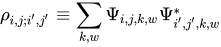 Diagonalize and form the
  matrix
  , which rows are the
  eigenvectors associated with the largest eigenvalues
  of . So is formed by the most significant eigenstates of the reduced density matrix. You choose looking to the parameter
  :
:  .
.
Step 4: New block and universe-block operatorsEdit
Form the matrix representation of operators for the system composite of the block and left-site, and for the system composite of right-site and universe-block, for example:




Now, form the  matrix representations of the new block and universe-block operators, form a new block by changing basis with the transformation , for example:

