The Galilei-covariant tensor formulation is a method for treating non-relativistic physics using the extended Galilei group as the representation group of the theory. It is constructed in the light cone of a five dimensional manifold.
Takahashi et. al., in 1988, began a study of Galilean symmetry, where an explicitly covariant non-relativistic field theory could be developed. The theory is constructed in the light cone of a (4,1) Minkowski space.[1][2][3][4] Previously, in 1985, Duval et. al. constructed a similar tensor formulation in the context of Newton–Cartan theory.[5] Some other authors also have developed a similar Galilean tensor formalism.[6][7]
Galilean ManifoldEditThe Galilei transformations are


where  stands for the three-dimensional Euclidean rotations,
  is the relative velocity determining Galilean boosts, a stands for spacial translations and b, for time translations. Consider a free mass particle
  ; the mass shell relation is given by
 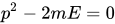 .
.
We can then define a 5-vector,  , with
  .
.
Thus, we can define a scalar product of the type

where
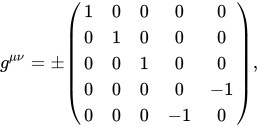
is the metric of the space-time, and  .[3]
.[3]
Extended Galilei AlgebraEdit
A five dimensional Poincaré algebra leaves the metric  invariant,
![{\displaystyle [P_{\mu },P_{\nu }]=0,}](https://wikimedia.org/api/rest_v1/media/math/render/svg/962f89d6eb3cb638b9c32374b3e8de33de9f9893)
![{\displaystyle {\frac {1}{i}}~[M_{\mu \nu },P_{\rho }]=g_{\mu \rho }P_{\nu }-g_{\nu \rho }P_{\mu }\,}](https://wikimedia.org/api/rest_v1/media/math/render/svg/fc1f53293f1b342df5b1e8f6f0f6b347a7b7cdf6)
![{\displaystyle {\frac {1}{i}}~[M_{\mu \nu },M_{\rho \sigma }]=g_{\mu \rho }M_{\nu \sigma }-g_{\mu \sigma }M_{\nu \rho }-g_{\nu \rho }M_{\mu \sigma }+\eta _{\nu \sigma }M_{\mu \rho }\,,}](https://wikimedia.org/api/rest_v1/media/math/render/svg/66851ee5747aa4447134ba26bcdb69c7c9c3edae)
We can write the generators as
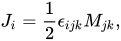


The non-vanishing commutation relations will then be rewritten as
![{\displaystyle \left[J_{i},J_{j}\right]=i\epsilon _{ijk}J_{k},}](https://wikimedia.org/api/rest_v1/media/math/render/svg/0bb2d2d89027d15928debbab2d6ec155f2655fe6)
![{\displaystyle \left[J_{i},C_{j}\right]=i\epsilon _{ijk}C_{k},}](https://wikimedia.org/api/rest_v1/media/math/render/svg/c5a58e4a9e13bc2142a74e5dc99ffe946b382fa9)
![{\displaystyle \left[D,K_{i}\right]=iK_{i},}](https://wikimedia.org/api/rest_v1/media/math/render/svg/e30869204b9dc5f947e4dba1ae637dc120419f78)
![{\displaystyle \left[P_{4},D\right]=iP_{4},}](https://wikimedia.org/api/rest_v1/media/math/render/svg/e65b560300ebc42af6482c17da2ed504185b940c)
![{\displaystyle \left[P_{i},K_{j}\right]=i\delta _{ij}P_{5},}](https://wikimedia.org/api/rest_v1/media/math/render/svg/5860936b48289db4c2abba772edb375fa7af65ca)
![{\displaystyle \left[P_{4},K_{i}\right]=iP_{i},}](https://wikimedia.org/api/rest_v1/media/math/render/svg/170c1c30310b1fc92b48ef9300f91bf3a5adb0fd)
![{\displaystyle \left[P_{5},D\right]=-iP_{5},}](https://wikimedia.org/api/rest_v1/media/math/render/svg/4c8013dd3d0f8af5524b4289357b8e53957bea9a)
![{\displaystyle \left[J_{i},K_{j}\right]=i\epsilon _{ijk}K_{k},}](https://wikimedia.org/api/rest_v1/media/math/render/svg/2569dc368096a0452e92b997ae81b6e48e39f70f)
![{\displaystyle \left[K_{i},C_{j}\right]=i\delta _{ij}D+i\epsilon _{ijk}J_{k},}](https://wikimedia.org/api/rest_v1/media/math/render/svg/c8b233bbc7fe85c8b4738cad1e96c1cf0697c828)
![{\displaystyle \left[C_{i},D\right]=iC_{i},}](https://wikimedia.org/api/rest_v1/media/math/render/svg/af6d83d3b0c0aba74addb22e5f38bc161d3395e3)
![{\displaystyle \left[J_{i},P_{j}\right]=i\epsilon _{ijk}P_{k},}](https://wikimedia.org/api/rest_v1/media/math/render/svg/6f0c16e812b80d363bbb58d2ece2210f739d4ab2)
![{\displaystyle \left[P_{i},C_{j}\right]=i\delta _{ij}P_{4},}](https://wikimedia.org/api/rest_v1/media/math/render/svg/b61e23d17cb09b06f62edf0a32c9dceb35f39061)
![{\displaystyle \left[P_{5},C_{i}\right]=iP_{i}.}](https://wikimedia.org/api/rest_v1/media/math/render/svg/24553d6a4507179531262d09f977915cf0fc1ff7)
An important Lie subalgebra is
![{\displaystyle [P_{4},P_{i}]=0}](https://wikimedia.org/api/rest_v1/media/math/render/svg/cd1be30e6fb29af9df98fb3aeb6a50f88f3779e8)
![[P_{i},P_{j}]=0](https://wikimedia.org/api/rest_v1/media/math/render/svg/98fc7c4a468ce7fa72d4ce1a447632324337ff52)
![{\displaystyle [J_{i},P_{4}]=0}](https://wikimedia.org/api/rest_v1/media/math/render/svg/7bf6448a5320cfcbabf97609d265707c11af193e)
![{\displaystyle [K_{i},K_{j}]=0}](https://wikimedia.org/api/rest_v1/media/math/render/svg/656e77e4fcd5e4f367b47df1c632d2c13ff171c2)
 is the generator of time translations (Hamiltonian), Pi is the generator of spatial translations (momentum operator),
  is the generator of Galilean boosts, and
  stands for a generator of rotations (angular momentum operator). The generator
  is a Casimir invariant and
  is an additional Casimir invariant. This algebra is isomorphic to the extended Galilean Algebra in (3+1) dimensions with
  , The central charge, interpreted as mass, and
  .[citation needed]
The third Casimir invariant is given by  , where
  is a 5-dimensional analog of the Pauli–Lubanski pseudovector.[citation needed]
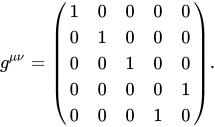
Bargmann structuresEditIn 1985 Duval, Burdet and Kunzle showed that four-dimensional Newton–Cartan theory of gravitation can be reformulated as Kaluza–Klein reduction of five-dimensional Einstein gravity along a null-like direction. The metric used is the same as the Galilean metric but with all positive entries
This lifting is considered to be useful for non-relativistic holographic models.[8] Gravitational models in this framework have shown to precisely calculate the mercury precession.