Gauge vector–tensor gravity

Gauge vector–tensor gravity[1] (GVT) is a relativistic generalization of Mordehai Milgrom's modified Newtonian dynamics (MOND) paradigm[2] where gauge fields cause the MOND behavior. The former covariant realizations of MOND such as the Bekenestein's tensor–vector–scalar gravity and the Moffat's scalar–tensor–vector gravity attribute MONDian behavior to some scalar fields. GVT is the first example wherein the MONDian behavior is mapped to the gauge vector fields. The main features of GVT can be summarized as follows:

  • As it is derived from the action principle, GVT respects conservation laws;
  • In the weak-field approximation of the spherically symmetric, static solution, GVT reproduces the MOND acceleration formula;
  • It can accommodate gravitational lensing.
  • It is in total agreement with the Einstein–Hilbert action in the strong and Newtonian gravities.

Its dynamical degrees of freedom are:

  • Two gauge fields;
  • A metric, .

DetailsEdit

The physical geometry, as seen by particles, represents the Finsler geometry–Randers type:

{\displaystyle ds={\sqrt {-g_{\mu \nu }dx^{\mu }dx^{\nu }}}+\left(B_{\mu }+{\widetilde {B}}_{\mu }\right)dx^{\mu }}

This implies that the orbit of a particle with mass m can be derived from the following effective action:

{\displaystyle S=m\int d\tau \left({\frac {1}{2}}{\dot {x}}^{\mu }{\dot {x}}^{\nu }g_{\mu \nu }+\left(B_{\mu }+{\widetilde {B}}_{\mu }\right){\dot {x}}^{\mu }\right).}

The geometrical quantities are Riemannian. GVT, thus, is a bi-geometric gravity.

ActionEdit

The metric's action coincides to that of the Einstein–Hilbert gravity:

{\displaystyle S_{\text{Grav}}={\frac {1}{16\pi G}}\int d^{4}x\,{\sqrt {-g}}R}

where R is the Ricci scalar constructed out from the metric. The action of the gauge fields follow:

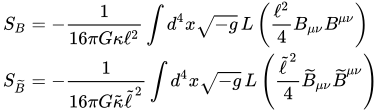
{\displaystyle {\begin{aligned}S_{B}&=-{\frac {1}{16\pi G\kappa \ell ^{2}}}\int d^{4}x{\sqrt {-g}}\,L\left({\frac {\ell ^{2}}{4}}B_{\mu \nu }B^{\mu \nu }\right)\\S_{\widetilde {B}}&=-{\frac {1}{16\pi G{\widetilde {\kappa }}{\widetilde {\ell }}^{2}}}\int d^{4}x{\sqrt {-g}}\,L\left({\frac {{\widetilde {\ell }}^{2}}{4}}{\widetilde {B}}_{\mu \nu }{\widetilde {B}}^{\mu \nu }\right)\end{aligned}}}

where L has the following MOND asymptotic behaviors

{\displaystyle L(x)={\begin{cases}x&x\gg 1\\{\frac {2}{3}}|x|^{\frac {3}{2}}&x\leqslant 1\end{cases}}}

and {\displaystyle \kappa ,{\widetilde {\kappa }}} represent the coupling constants of the theory while {\displaystyle \ell ,{\widetilde {\ell }}} are the parameters of the theory and {\displaystyle \ell <{\widetilde {\ell }}.}

Coupling to the matterEdit

Metric couples to the energy-momentum tensor. The matter current is the source field of both gauge fields. The matter current is

{\displaystyle J^{\mu }=\rho u^{\mu }}

where \rho  is the density and u^{\mu } represents the four velocity.

Regimes of the GVT theoryEdit

GVT accommodates the Newtonian and MOND regime of gravity; but it admits the post-MONDian regime.

Strong and Newtonian regimesEdit

The strong and Newtonian regime of the theory is defined to be where holds:

{\displaystyle {\begin{aligned}L\left({\frac {\ell ^{2}}{4}}B_{\mu \nu }B^{\mu \nu }\right)&={\frac {\ell ^{2}}{4}}B_{\mu \nu }B^{\mu \nu }\\L\left({\frac {{\widetilde {\ell }}^{2}}{4}}{\widetilde {B}}_{\mu \nu }{\widetilde {B}}^{\mu \nu }\right)&={\frac {{\widetilde {\ell }}^{2}}{4}}{\widetilde {B}}_{\mu \nu }{\widetilde {B}}^{\mu \nu }\end{aligned}}}

The consistency between the gravitoelectromagnetism approximation to the GVT theory and that predicted and measured by the Einstein–Hilbert gravity demands that

{\displaystyle \kappa +{\widetilde {\kappa }}=0}

which results in

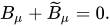
{\displaystyle B_{\mu }+{\widetilde {B}}_{\mu }=0.}

So the theory coincides to the Einstein–Hilbert gravity in its Newtonian and strong regimes.

MOND regimeEdit

The MOND regime of the theory is defined to be
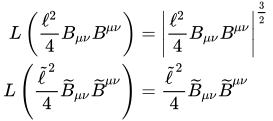
{\displaystyle {\begin{aligned}L\left({\frac {\ell ^{2}}{4}}B_{\mu \nu }B^{\mu \nu }\right)&=\left|{\frac {\ell ^{2}}{4}}B_{\mu \nu }B^{\mu \nu }\right|^{\frac {3}{2}}\\L\left({\frac {{\widetilde {\ell }}^{2}}{4}}{\widetilde {B}}_{\mu \nu }{\widetilde {B}}^{\mu \nu }\right)&={\frac {{\widetilde {\ell }}^{2}}{4}}{\widetilde {B}}_{\mu \nu }{\widetilde {B}}^{\mu \nu }\end{aligned}}}

So the action for the B_{\mu } field becomes aquadratic. For the static mass distribution, the theory then converts to the AQUAL model of gravity[3] with the critical acceleration of

{\displaystyle a_{0}={\frac {4{\sqrt {2}}\kappa c^{2}}{\ell }}}

So the GVT theory is capable of reproducing the flat rotational velocity curves of galaxies. The current observations do not fix \kappa  which is supposedly of order one.

Post-MONDian regimeEdit

The post-MONDian regime of the theory is defined where both of the actions of the {\displaystyle B_{\mu },{\widetilde {B}}_{\mu }} are aquadratic. The MOND type behavior is suppressed in this regime due to the contribution of the second gauge field. 


This article uses material from the Wikipedia article
 Metasyntactic variable, which is released under the 
Creative Commons
Attribution-ShareAlike 3.0 Unported License
.