In theoretical physics, the logarithmic Schrödinger equation (sometimes abbreviated as LNSE or LogSE) is one of the nonlinear modifications of Schrödinger's equation. It is a classical wave equation with applications to extensions of quantum mechanics,[1][2][3] quantum optics,[4] nuclear physics,[5][6] transport and diffusion phenomena,[7][8] open quantum systems and information theory,[9][10][11][12][13][14] effective quantum gravity and physical vacuum models[15][16][17][18] and theory of superfluidity and Bose–Einstein condensation.[19][20] Its relativistic version (with D'Alembertian instead of Laplacian and first-order time derivative) was first proposed by Gerald Rosen.[21] It is an example of an integrable model.
The equation
The logarithmic Schrödinger equation is the partial differential equation. In mathematics and mathematical physics one often uses its dimensionless form:
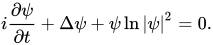
for the complex-valued function ψ = ψ(x, t) of the particles position vector x = (x, y, z) at time t, and
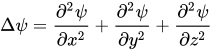
is the Laplacian of ψ in Cartesian coordinates. The logarithmic term 
The relativistic version of this equation can be obtained by replacing the derivative operator with the D'Alembertian, similarly to the Klein–Gordon equation. Soliton-like solutions known as Gaussons figure prominently as analytical solutions to this equation for a number of cases.
| This article uses material from the Wikipedia article Metasyntactic variable, which is released under the Creative Commons Attribution-ShareAlike 3.0 Unported License. |