Scalar–tensor–vector gravity (STVG)[1] is a modified theory of gravity developed by John Moffat, a researcher at the Perimeter Institute for Theoretical Physics in Waterloo, Ontario. The theory is also often referred to by the acronym MOG (MOdified Gravity).
OverviewEditScalar–tensor–vector gravity theory,[2] also known as MOdified Gravity (MOG), is based on an action principle and postulates the existence of a vector field, while elevating the three constants of the theory to scalar fields. In the weak-field approximation, STVG produces a Yukawa-like modification of the gravitational force due to a point source. Intuitively, this result can be described as follows: far from a source gravity is stronger than the Newtonian prediction, but at shorter distances, it is counteracted by a repulsive fifth force due to the vector field.
STVG has been used successfully to explain galaxy rotation curves,[3] the mass profiles of galaxy clusters,[4] gravitational lensing in the Bullet Cluster,[5] and cosmological observations[6] without the need for dark matter. On a smaller scale, in the Solar System, STVG predicts no observable deviation from general relativity.[7] The theory may also offer an explanation for the origin of inertia.[8]
Mathematical detailsEditSTVG is formulated using the action principle. In the following discussion, a metric signature of ![[+,-,-,-]](https://wikimedia.org/api/rest_v1/media/math/render/svg/aac20348c9806cad564d1e470a20a3b51d3c513f) will be used; the speed of light is set to
will be used; the speed of light is set to  , and we are using the following definition for the Ricci tensor:

We begin with the Einstein–Hilbert Lagrangian:

where  is the trace of the Ricci tensor,
  is the gravitational constant,
  is the determinant of the metric tensor
  , while
  is the cosmological constant.
We introduce the Maxwell-Proca Lagrangian for the STVG vector field  :
:
![{\displaystyle {\mathcal {L}}_{\phi }=-{\frac {1}{4\pi }}\omega \left[{\frac {1}{4}}B^{\mu \nu }B_{\mu \nu }-{\frac {1}{2}}\mu ^{2}\phi _{\mu }\phi ^{\mu }+V_{\phi }(\phi )\right]{\sqrt {-g}},}](https://wikimedia.org/api/rest_v1/media/math/render/svg/d9e28f5d1817e1185ea2b5a4f68f71922a0a2180)
where  is the mass of the vector field,
  characterizes the strength of the coupling between the fifth force and matter, and
  is a self-interaction potential.
The three constants of the theory,  and
and  are promoted to scalar fields by introducing associated kinetic and potential terms in the Lagrangian density:
![{\displaystyle {\mathcal {L}}_{S}=-{\frac {1}{G}}\left[{\frac {1}{2}}g^{\mu \nu }\left({\frac {\nabla _{\mu }G\nabla _{\nu }G}{G^{2}}}+{\frac {\nabla _{\mu }\mu \nabla _{\nu }\mu }{\mu ^{2}}}-\nabla _{\mu }\omega \nabla _{\nu }\omega \right)+{\frac {V_{G}(G)}{G^{2}}}+{\frac {V_{\mu }(\mu )}{\mu ^{2}}}+V_{\omega }(\omega )\right]{\sqrt {-g}},}](https://wikimedia.org/api/rest_v1/media/math/render/svg/94061e1317e8fd0d95b330e07a58d226a8d35cf0)
where  denotes covariant differentiation with respect to the metric
  while
while  and
and  are the self-interaction potentials associated with the scalar fields.
The STVG action integral takes the form

where  is the ordinary matter Lagrangian density.
Spherically symmetric, static vacuum solutionEditThe field equations of STVG can be developed from the action integral using the variational principle. First a test particle Lagrangian is postulated in the form

where  is the test particle mass,
  is a factor representing the nonlinearity of the theory,
  is the test particle's fifth-force charge, and
 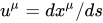 is its four-velocity. Assuming that the fifth-force charge is proportional to mass, i.e.,
  the value of
 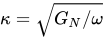 is determined and the following equation of motion is obtained in the spherically symmetric, static gravitational field of a point mass of mass
  :
:
![{\displaystyle {\ddot {r}}=-{\frac {G_{N}M}{r^{2}}}\left[1+\alpha -\alpha (1+\mu r)e^{-\mu r}\right],}](https://wikimedia.org/api/rest_v1/media/math/render/svg/c091ee25d835a3cf68808266a06eabb1221ae58f)
where  is Newton's constant of gravitation. Further study of the field equations allows a determination of and
  for a point gravitational source of mass in the form[9]

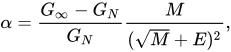
where  is determined from cosmological observations, while for the constants
  and
and  galaxy rotation curves yield the following values:

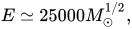
where  is the mass of the Sun. These results form the basis of a series of calculations that are used to confront the theory with observation.
ObservationsEditSTVG/MOG has been applied successfully to a range of astronomical, astrophysical, and cosmological phenomena.
On the scale of the Solar System, the theory predicts no deviation[7] from the results of Newton and Einstein. This is also true for star clusters containing no more than a few million solar masses.[citation needed]
The theory accounts for the rotation curves of spiral galaxies,[3] correctly reproducing the Tully-Fisher law.[9]
STVG is in good agreement with the mass profiles of galaxy clusters.[4]
STVG can also account for key cosmological observations, including:[6]
- The acoustic peaks in the cosmic microwave background radiation;
- The accelerating expansion of the universe that is apparent from type Ia supernova observations;
- The matter power spectrum of the universe that is observed in the form of galaxy-galaxy correlations.