Weyl transformation

In theoretical physics, the Weyl transformation, named after Hermann Weyl, is a local rescaling of the metric tensor:

See also Wigner–Weyl transform, for another definition of the Weyl transform.

which produces another metric in the same conformal class. A theory or an expression invariant under this transformation is called conformally invariant, or is said to possess Weyl invariance or Weyl symmetry. The Weyl symmetry is an important symmetry in conformal field theory. It is, for example, a symmetry of the Polyakov action. When quantum mechanical effects break the conformal invariance of a theory, it is said to exhibit a conformal anomaly or Weyl anomaly.

The ordinary Levi-Civita connection and associated spin connections are not invariant under Weyl transformations. An appropriately invariant notion is the Weyl connection, which is one way of specifying the structure of a conformal connection.

Conformal weightEdit

A quantity \varphi  has conformal weight k if, under the Weyl transformation, it transforms via


   \varphi \to \varphi e^{k \omega}.

Thus conformally weighted quantities belong to certain density bundles; see also conformal dimension. Let A_{\mu } be the connection one-form associated to the Levi-Civita connection of g. Introduce a connection that depends also on an initial one-form \partial_\mu\omega via


   B_\mu = A_\mu + \partial_\mu \omega.

Then D_\mu \varphi \equiv \partial_\mu \varphi + k B_\mu \varphi is covariant and has conformal weight k - 1.

FormulasEdit

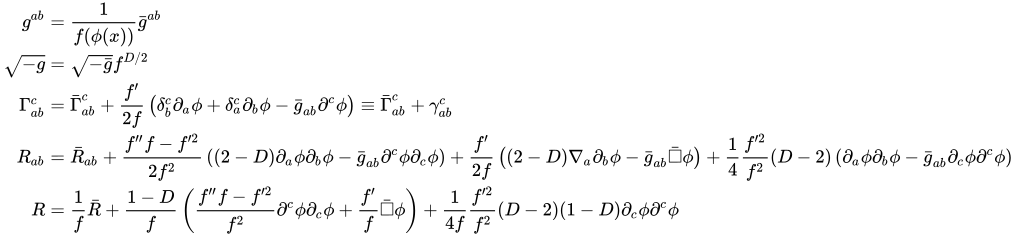
For the transformation

{\displaystyle g_{ab}=f(\phi (x)){\bar {g}}_{ab}}

We can derive the following formulas

{\displaystyle {\begin{aligned}g^{ab}&={\frac {1}{f(\phi (x))}}{\bar {g}}^{ab}\\{\sqrt {-g}}&={\sqrt {-{\bar {g}}}}f^{D/2}\\\Gamma _{ab}^{c}&={\bar {\Gamma }}_{ab}^{c}+{\frac {f'}{2f}}\left(\delta _{b}^{c}\partial _{a}\phi +\delta _{a}^{c}\partial _{b}\phi -{\bar {g}}_{ab}\partial ^{c}\phi \right)\equiv {\bar {\Gamma }}_{ab}^{c}+\gamma _{ab}^{c}\\R_{ab}&={\bar {R}}_{ab}+{\frac {f''f-f^{\prime 2}}{2f^{2}}}\left((2-D)\partial _{a}\phi \partial _{b}\phi -{\bar {g}}_{ab}\partial ^{c}\phi \partial _{c}\phi \right)+{\frac {f'}{2f}}\left((2-D)\nabla _{a}\partial _{b}\phi -{\bar {g}}_{ab}{\bar {\Box }}\phi \right)+{\frac {1}{4}}{\frac {f^{\prime 2}}{f^{2}}}(D-2)\left(\partial _{a}\phi \partial _{b}\phi -{\bar {g}}_{ab}\partial _{c}\phi \partial ^{c}\phi \right)\\R&={\frac {1}{f}}{\bar {R}}+{\frac {1-D}{f}}\left({\frac {f''f-f^{\prime 2}}{f^{2}}}\partial ^{c}\phi \partial _{c}\phi +{\frac {f'}{f}}{\bar {\Box }}\phi \right)+{\frac {1}{4f}}{\frac {f^{\prime 2}}{f^{2}}}(D-2)(1-D)\partial _{c}\phi \partial ^{c}\phi \end{aligned}}}

Note that the Weyl tensor is invariant under a Weyl rescaling. 


This article uses material from the Wikipedia article
 Metasyntactic variable, which is released under the 
Creative Commons
Attribution-ShareAlike 3.0 Unported License
.